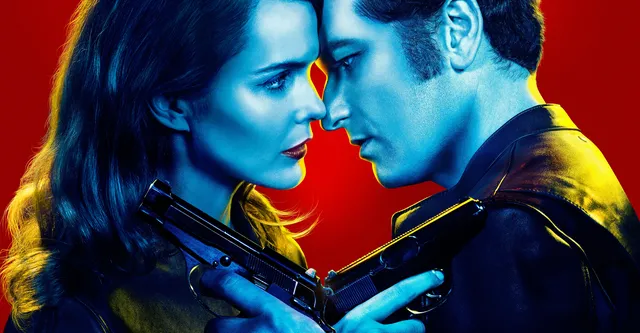
'The Americans' Ending, Explained

When I think about the perfect series finale, it's always, without question, the quietly compelling masterpiece we get in The Americans (2013). The emotions that watching live stirred at the realization that a frequently action-packed show wasn't going to deliver an epic blowout, but instead it'd cut deep with a few simple confrontations, is still something I think about as both a critic and a fan. In more ways than one, it's the best way to subvert expectations—to take us on a staggering fallout that'll haunt in a way few other shows could.
I don't remember the last line in most shows or movies. But I remember the last line in The Americans. Because it's that very line that cements that the show's always been about a family, not spies—not secrets or lies. It's a twisted version of it, to be sure, but it fits the essence of this show perfectly.
'The American's Garage Scene With Stan Is Still the Best Confrontation on TV

When a confrontation is years in the making, it's easy to expect it to be a massive outburst. And how we often define those outbursts is through loud, perhaps even violent fits of rage. Yet, what The Americans delivers is a quiet, profoundly rupturing conversation that's made twice as harrowing by some of the finest performances on TV. Matthew Rhys, Noah Emmerich, Keri Russell, and Holly Taylor each deliver career-best performances in this scene, underscored by emotional sincerity in a manner that's indescribable.
"We had a job to do," Philip first tells Stan, revealing to both him and us that by the end, it's all it was for him—a job. A means to an end that he hated and couldn't wrap his head around, but the best thing it brought him were his wife and kids. "You were my best friend," Stan tells him, and the simple words coming from a grown man's mouth are more gutting than anything else because they're what verify just how awful the betrayal is to him. (The past tense of the word; the look on his face; the deep vulnerability.) How he trusted Philip in a way he never thought possible and how both men found something sincere through the cracks of all the anguish they endured.

This confrontation results in the kind of scene that I wish someone would teach a masterclass on. From the screenplay to the performances and how every directorial choice emphasizes the stakes is no small feat, and a huge accomplishment from every angle. The weight of the words echoes through the static of the parking lot, and that fact alone is something that I think about frequently. For a show that's always been exceptional with its needle drops, the white noise in this moment is perhaps one of the most gutting sounds.
In many ways, it's proof of how powerful words can be. How sometimes, the right phrases—a skill Philip's particularly good at—can be the catalyst in how everything unravels. For a simple scene, the words drive it. They brilliantly act as both character studies and a means for the plot to move forward. They're harrowing, heavy, and so achingly vulnerable in what they convey that Philip and Elizabeth getting caught turns into a lesson on transparency. It becomes a moment that explores how fragile they all are in their human states, despite the jobs they were each tasked to do.

Stan's entire career has been building to this moment, but he lets them go. Quietly, he accepts that he has to watch over their son, Henry, and quietly, he recognizes that there's nothing left. The show also never answers whether his wife Renee (Laurie Holden) is also involved with the KGB or not, making this moment all the more haunting in all that Stan has to carry.
On any other show, one or all of them would've died. It'd be a bloodbath, but The Americans ends its final mission through subdued contemplation. Stan lets them go, and there's perhaps nothing more powerful than that, no matter which angle we look at it through. There's perhaps no moment that proves, as he tells them in his heartbreak, that he would've done anything for them. Here, he does.
How Paige's Decision Makes Perfect Sense for the Jennings Family

I still can't remember a time when a teenage girl on TV got as much vitriol as Paige Jennings did. With every single person who got online to talk about how "annoying" she was must've forgotten what so many of us were like as teenagers. Yet, in The Americans finale, Paige is, without a shadow of a doubt, the bravest character. She's the one left with the most agency, and her final decision makes for another moment that people could study in terms of how to write compelling character development.
At the end of the day, Paige is an eldest daughter. There's so much encompassed in that title alone, but the weight Paige has carried with the knowledge of who her parents are and what they've done is something no kid should've ever had to endure. And to think that even for a moment she would've left her brother is what makes those final few moments of a girl standing alone at the train station so gut-wrenching. Because there's no world in which Russia could ever be Paige's home without Henry.
Holly Taylor's performance throughout those final few moments is, in short, indescribable. It's something you could feel viscerally, especially if, like me, you're also the eldest sibling. I'd choose my sibling, over and over again, without question. It makes perfect sense that Paige does, too, and it makes the final scene of Philip and Elizabeth standing alone so haunting.
What Is the Last Line in 'The Americans?'

Some last lines say very little. It's a look more than it's an actual line we focus on. Some are simple, but they feel universal. With The Americans, we get statements that not only leave the audience with hope, but they definitively put a stamp on the idea of family. They make it clear that this show was never about espionage or high stakes, but about raising kids in a foreign country, when everything else around you is built on lies. It was a love story, leaving a man and a woman standing alone in the country that's now foreign to him as they look over at the skyline and realize that nothing could ever be the same.
"They'll be okay," Elizabeth starts, talking about Paige and Henry. Philip continues, "They'll remember us. They're not kids anymore." And then, finally, in Russian, Elizabeth says, "We'll get used to it." If I could write another dissertation, study another piece of text extensively, it'd be The Americans finale.