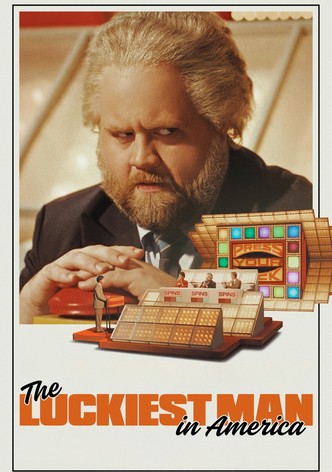
Most titles on streaming charts usually move by a few places at most. But The Luckiest Man in America has made an extraordinary placement leap, jumping a staggering 3,399 spots on the JustWatch streaming charts. That kind of movement rarely happens by accident. It usually signals that people aren't just stumbling onto the film, they're actively looking for it.
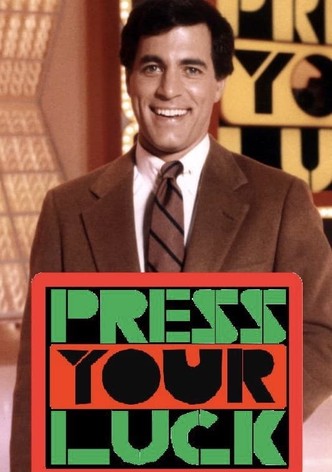
Directed by Samir Oliveros and starring Paul Walter Hauser, The Luckiest Man in America is a semi-fictionalized retelling of Michael Larson's infamous 1984 appearance on the popular Press Your Luck game show, where he memorized the game board's patterns and won over $110,000 in cash and prizes. On paper, it sounds like the perfect feel-good underdog story.
In practice, the film is far more psychological and emotionally complicated than many viewers expect. And that may be exactly why it's trending. Divisive movies often chart higher than universally "pleasant" ones, because they make people want to watch for themselves instead of relying on consensus. It also reflects a growing cultural conversation around what this film is trying to say about success and power.
Why 'The Luckiest Man in America' Is So Divisive
Many viewers go in expecting a clever, even lighthearted caper about a man gaming a game show. What they get instead is something much heavier since The Luckiest Man in America is essentially about the cost of outsmarting a system never designed for fairness. The movie also portrays the show's producers as increasingly intrusive and manipulative, pushing the drama into near-thriller territory.
This makes for a great story, but it also really blurs the line between historical accuracy and dramatic license. While some viewers appreciate that as a creative choice, others feel that it unfairly turns real people into villains. However, the most divisive part of the film is probably Michael Larson, who isn't framed as a traditional hero. He's awkward and comes across as emotionally fragile. As a result, his story doesn't feel triumphant so much as exhausting.
For audiences conditioned to expect clean arcs and satisfying wins, that can be frustrating. For others, it's exactly what makes the story feel honest. That said, The Luckiest Man in America is a film that refuses to reassure. It suggests that winning doesn't automatically bring peace, belonging, or happiness. And that's a message not everyone wants from an underdog story.
The Real-Life Story Behind 'The Luckiest Man in America'
Michael Larson's real story is one of the rare scandals built on intelligence rather than crime. He didn't hack the system, tamper with equipment, or receive inside help. He simply studied a flawed design until he understood it better than its creators. CBS executives initially believed Larson cheated. But after reviewing the footage thoroughly, they found no rule violation or evidence of tampering.
What makes Larson's real story even more complicated is what happened after the cameras stopped rolling. His winnings didn't lead to stability or long-term success. Much of the money was spent quickly, some of it on lavish gifts and impulsive decisions, and some of it on risky financial schemes that would later unravel. The irony is hard to ignore.
The moment that proved he was capable of extraordinary focus and discipline was followed by a series of choices that showed how difficult it was for him to sustain either. That contrast is part of why Larson remains such a polarizing figure. To some, he's a modern folk hero who outsmarted a flawed system. To others, he's a cautionary tale about intelligence without direction.
Why 'The Luckiest Man in America' Resonates With Viewers Right Now
The short answer is that viewers want to believe that someone like them could walk into a rigid structure and change the outcome. Financial anxiety is part of everyday life for many people. Rising costs, job instability, and shrinking safety nets make stories of sudden financial reversal feel especially relevant. Larson represents a kind of miracle scenario in which one moment changes everything.
Larson's story has been revisited many times because it exists at the intersection of television history and cultural myth-making. After the 1994 film Quiz Show reignited interest in game show scandals, Larson appeared on Good Morning America to reflect on his own moment in the spotlight. But it was the 2003 documentary Big Bucks: The Press Your Luck Scandal that truly revived his story.
The Luckiest Man in America, which can be found on Prime Video and Hulu, isn't for viewers looking for comfort or easy inspiration. It's best suited to people who enjoy psychological dramas and audiences interested in real-life scandals with a moral complexity twist. It's also more of a conversation starter than a crowd pleaser. But judging by its position at number 46 on the JustWatch charts, it's exactly the kind of film people are looking for.