Everyone Sucks in Splitsville - and That's Why It Works So Well

From the very beginning, you know what you’re getting yourself into with Splitsville. It’s billed as an “unromantic comedy,” so you can already expect it to defy a certain amount of convention. And with its slapstick comedy, full-frontal nudity, and focus on non-monogamy, it certainly does. However, no matter what movie you watch, there are certain conventions that almost always ring true.
Take, for example, the protagonist — usually, they’ll be the hero of the story, like your run-of-the-mill rom-com hero in every rom-com ever. Or maybe they’ll be an anti-hero, Marty Supreme-style, where you know they aren’t particularly nice or heroic, but you find yourself somehow rooting for them anyway.
But in Splitsville, neither of these principles applies. The characters are near-impossible to root for. But strangely, that ends up working in the movie’s favour. (Spoilers ahead!)
Why Everyone in Splitsville Is Terrible
In my opinion, everyone in Splitsville is either a covert narcissist or an out-and-out narcissist. Even the child.
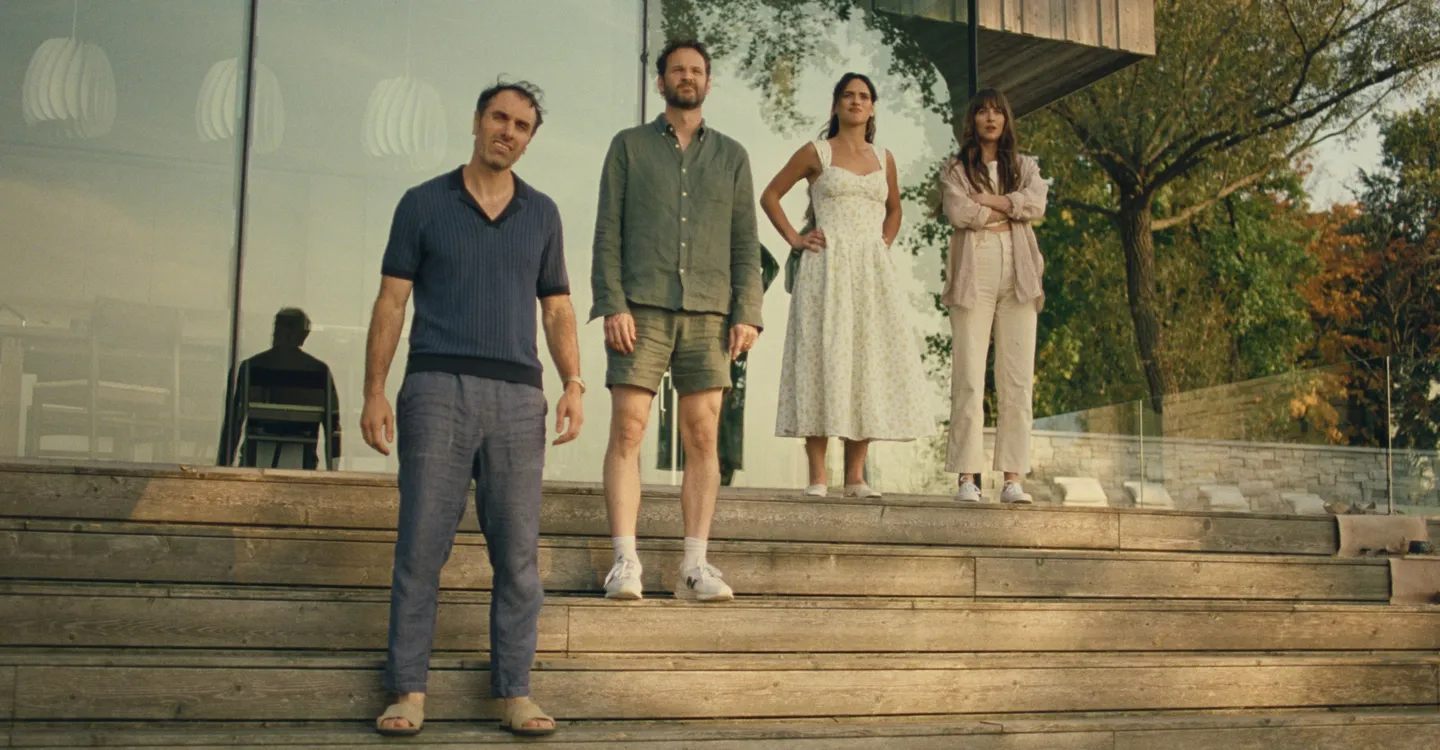
Let’s start with the men. So-called “best friends” Carey (Kyle Marvin) and Paul (Michael Angelo Covino) are two sides of the same self-absorbed coin. While Carey puts on this ‘down-on-his-luck but endearing loser’ act that is so convincing in most rom-coms, it’s impossible to buy it. He spends most of the movie feeling sorry for himself because his wife, Ashley (Adria Arjona), wants to divorce him, and uses that to justify a string of terrible decisions — the main one being not just sleeping with his best friend’s wife, but eventually moving in and stealing his entire life.
But Paul himself is hardly an angel. In fact, he is probably the worst person in the movie. He commits several unforgivable sins, including the identity fraud of his young son, and even when his actions land him in prison, he refuses to be humbled. He just can’t stop himself from scheming, cheating, and wheedling his way through life, with his schemes becoming more outlandish and more unjustifiable as the film progresses.
However, if you were going to pity the women in this film instead, I’m going to stop you right there. They are also, literally, the worst. Like Carey, Julie (Dakota Johnson) tries to paint herself as the victim who is somehow morally superior, yet spends the whole movie arguably using Carey as a stand-in for her husband without actually being invested in him. While, as I said, I don’t feel bad for Carey, that doesn’t make her using him as a crutch to avoid confronting her mess of a life okay.
Moreover, right from the outset, we are told we should dislike Ashley for the callous way she admits to repeatedly cheating on Carey, dumping him, and trying to oust him from his own home while she brings in a revolving door of lovers. But this isn’t a “she’s not so bad, you go girl” kind of situation. She really is that bad. We’re right to hate her. Ironically, she is probably the most pathetic character in the film, even though she is the only one who doesn’t actively try to act that way to elicit sympathy. She really just operates with that little self-awareness.
And the child? Well, he just can’t stop stealing people’s jet skis.
Why Splitsville’s Terrible Characters Work So Well
While the four adults in this film have their own individual brand of awfulness, all of them believe themselves to be the heroes of their own stories. They all believe they are the protagonists in their own imagined narratives, making them all incredibly arrogant and, to a degree, deluded.
Their reliance on non-monogamy as a concept throughout the film is just one example of how the characters effectively try to reason themselves out of consequences, even though non-monogamy is something that relies on boundaries and mutual respect.
But the best thing about Splitsville is that the consequences come thick and fast for these characters, whether that be through slapstick beatdowns or literal prison. By making them such bad people, the writers have removed the need to feel sorry for these characters. This means that seeing them experience misfortune is especially delicious. It’s like getting a front-row seat to a humiliation ritual, or throwing rotten fruit at people in wooden stocks in the Middle Ages.
That being said, things end a little too neatly for this dysfunctional quadrant. They end up more or less in the same position as they were at the start, and as much as it pains me to say it, they even seem a little happy. It makes me wish that the writers stuck to the landing a little more, but I’m confident in the knowledge that, given none of these characters have experienced any kind of growth, this equilibrium probably won’t last. Roll on Splitsville 2.