The Ending of Harry Potter, Explained

Harry Potter is one of the most iconic and well-known franchises in history. Seven books, eight movies, and one stage play later, the global sensation is returning in the form of an ambitious TV series on HBO Max. The plan is that each season of the series will adapt one of author JK Rowling’s books, introducing the myth of the Boy Who Lived to a whole new generation.
The final instalment in the Harry Potter film series, Harry Potter and the Deathly Hallows Part 2, came out in 2011, making it a whole fifteen years since we waved goodbye to Harry, Ron, and Hermione one last time. Collectively, the films amassed billions at the global box-office. The Fantastic Beasts spin-off series followed, and was moderately successful in its own ways, but it never quite managed to fill the Harry Potter-shaped hole in the nation’s hearts.
As we prepare to return to Hogwarts once more, it feels only appropriate to look back at the ending of Harry Potter and the Deathly Hallows Part 2 and the final moments of the magical saga.
Who Died In The Battle Of Hogwarts?

The Battle of Hogwarts served as the climax of not just the movie, but the Second Wizarding War as a whole. Harry, Ron, and Hermione never actually had a chance to enjoy their final year of Hogwarts as they were effectively on the run after Voldemort and his Death Eaters seized total control over the Wizarding World. Instead, they focused their efforts on gathering all the Horcruxes needed to defeat the Dark Wizard once and for all. Their return to Hogwarts set the wheels in motion for this thrilling final battle — but it came with a lot of sacrifice.
Members of the Order of the Phoenix and Dumbledore’s Army were among those who died. Remus Lupin and Nymphadora Tonks, who had only recently welcomed their infant son, Teddy Lupin, ultimately died during their respective duels, leaving Teddy orphaned, just like Harry was. As Harry’s last remaining father figure, Lupin's death was especially poignant. But, they weren’t the only Order members who met an untimely end. Much to the chagrin of many fans, Fred Weasley also met his maker, leaving twin brother George alone and the entirety of the Weasley family devastated. Colin Creevey, who you might remember as the eager photographer from Harry Potter and the Chamber of Secrets, also died in battle, as did Lavender Brown. As Hogwarts students, their deaths hit especially hard, but at least they died as heroes.
Severus Snape was another significant character who met his end. Believing he was the true master of the Elder Wand, Voldemort got Nagini to kill Snape, piercing his neck with its venomous fangs. Harry then approached a dying Snape, who instructed him to “take” what turned out to be a number of his memories. When Harry put these memories into the Pensieve, he learned the truth: Snape had been protecting him all along.
Amid all this death, there was one character that we were all glad to see the back of: Bellatrix Lestrange. As well as torturing Neville Longbottom’s parents to the point of insanity and killing beloved characters Dobby and Sirius Black, viewers were given even more reason to hate Bellatrix during the Battle of Hogwarts: she killed Tonks, her own niece.
It was Molly Weasley who finally put an end to Bellatrix’s reign of terror in a nail-biting duel that ended in the most satisfying way possible.
How Did Harry Defeat Voldemort?

From the Pensieve, Harry also learns that he is the final Horcrux — he became one after Voldemort’s Killing Curse rebounded on him as a baby. It seems like the only way to kill Voldemort is for him to die too. So, he heads to the Forbidden Forest to face him. Before he does, it is revealed that the first ever Golden Snitch he caught encases the Resurrection Stone. After an emotional conversation with his parents, Lupin, and Sirius, he goes to Voldemort, who hits him with the Killing Curse. This paves way for another emotional conversation, this time with Dumbledore. It seems to be some kind of purgatory-like setting in Harry’s mind, based on King’s Cross Station, of all places, but after this conversation, Harry wakes up.
The reason Harry didn’t die was because Voldemort tried to kill him with the Elder Wand. Unbeknownst to Voldemort, Harry was the true master of the Elder Wand after successfully disarming Malfoy, who was the previous Elder Wand master when he disarmed Dumbledore. An important part of the Elder Wand’s lore is that whoever disarms the previous owner becomes the new owner of the wand. In addition to this, the Elder Wand won’t harm its owner. So, when Voldemort used the Elder Wand to try and kill Harry, it killed the Horcrux inside Harry, but not Harry himself.
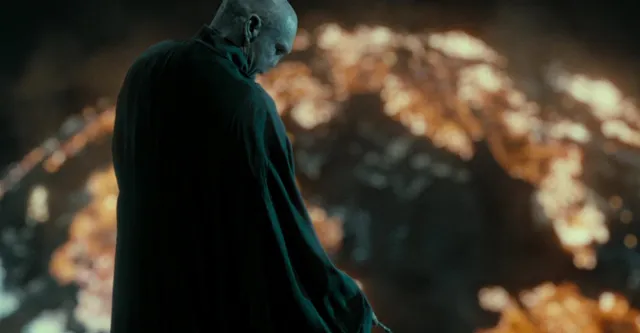
This leads us to that iconic final scene where Harry and Voldemort’s respective spells (Expelliarmus and Avada Kedavra) connect. It seems weird that such a weak spell compared to the Killing Curse would kill the Dark Lord, but the reason for this all has to do with the Elder Wand. As previously mentioned, the Elder Wand won’t harm its owner. So, when Voldemort tries to use it to kill Harry with another Killing Curse, that spell backfires and ends up killing him, instead. The disarming spell probably helped a bit, too.
With all the Horcruxes destroyed by that point, it was finally time to say bye-bye to Voldemort. The Battle of Hogwarts, and the Second Wizarding War, was over. Harry also destroyed the Elder Wand for good measure, ensuring nothing like that could ever happen again.
The movie ends with a cute epilogue 19 years later, with Harry, Ron, and Hermione waving their children off to Hogwarts.